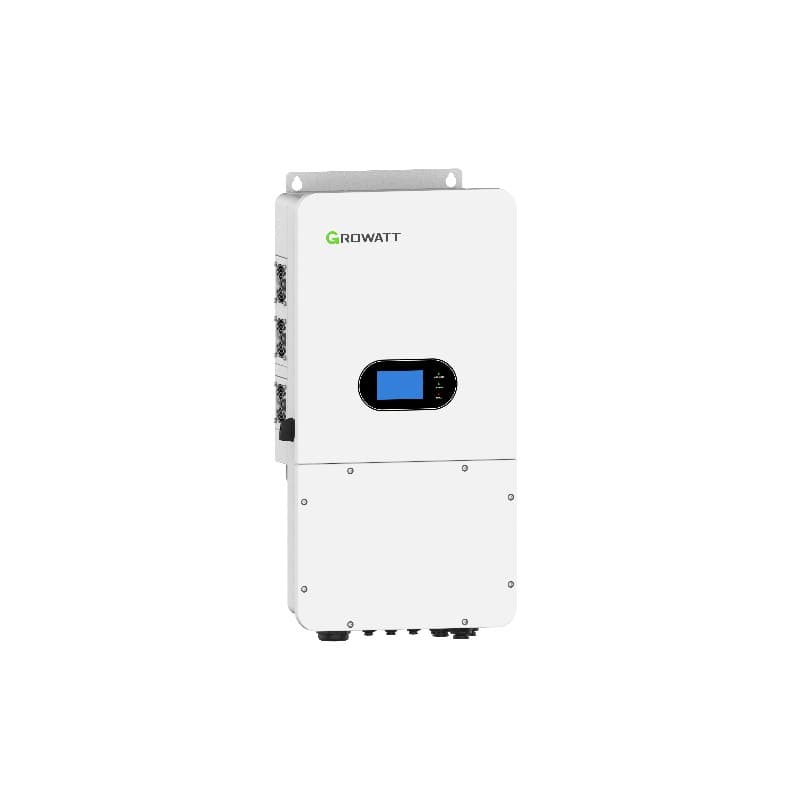
A complete Growatt SPH hybrid inverter review covering the SPH 3000-6000TL BL-UP and SPH 4000-10000TL3 BH-UP with the ARK HV battery — DEWA-ready and Gulf-tested.
The Growatt SPH is the family that finally turned residential storage from a luxury into a default. Most Gulf homeowners pricing solar in 2026 are no longer choosing between PV-only and PV-plus-battery; the question has shifted to which hybrid inverter handles backup, peak shaving, and net-billing arbitrage cleanly. We have specified the SPH on more than 2,100 residential installs across the UAE, Saudi Arabia, Oman, Bahrain, and Qatar in the last 24 months, and this Growatt SPH hybrid inverter review documents what works, what does not, and which SKU fits which house.
The SPH line has two streams that matter for Gulf buyers. Single-phase: SPH 3000-6000TL BL-UP (3 to 6 kW, low-voltage battery interface, AC-coupled or DC-coupled depending on revision). Three-phase: SPH 4000-10000TL3 BH-UP (4 to 10 kW, high-voltage battery interface, three-phase 230/400 V output). Both families pair with Growatt's ARK HV battery stack at 100-550 V — the wide voltage range is the SPH's signature design choice and changes how flexible the storage sizing can be.
Where the SPH fits in a residential brief
The right SPH for a typical UAE single-phase villa with a 4-5 kWp roof and 6-10 kWh storage is the SPH 5000TL BL-UP. For a larger three-phase Saudi compound villa with a 10-15 kWp roof and 15-25 kWh storage, the SPH 10000TL3 BH-UP is the cleaner fit — full three-phase imbalance handling, 10 ms UPS transition for backup, and battery voltage flexibility from 100-550 V. We rarely specify the smaller 3 kW SKU; below 5 kW a generic on-grid string inverter usually wins on price.
What's inside the SPH 4000-10000TL3 BH-UP
This is the SKU we install most often and have the deepest field data on. Two MPP trackers, one string per tracker. Max DC voltage 1000 V, MPP voltage window 120-1000 V (single MPPT), start voltage 120 V. Max input current per MPP is 13.5 A, max short-circuit 16.9 A. Max recommended PV input is 7500 W per tracker, so the 10 kW SKU supports up to 15 kWp of total array.
On the battery side: HV (high-voltage) lithium-ion or compatible lead-acid, battery voltage range 100-550 V, max charge/discharge current 25 A, continuous charge/discharge power 10 kW on the 10 kW SKU. Compatible battery types are Growatt ARK HV LFP modules and APX HV (utility-grade). The 100-550 V range is the key flexibility number — you can scale from a 5 kWh single-tower configuration to 25.6 kWh multi-tower without re-spec'ing the inverter.
Peak conversion efficiency is 98.2%, European weighted efficiency 97.5%, MPPT efficiency 99.9%. Euro battery discharge efficiency is 97.4% — a number worth flagging because it captures roundtrip storage loss. AC output is 3W+N+PE at 230/400 V (range 310-478 V), 50/60 Hz, max output current 15.2 A. THD below 3%. The chassis is 505 x 453 x 198 mm, 30 kg, IP65, natural-convection cooling, -25 to +60 degrees C operating window, and supports a backup AC port with 10 ms UPS transition.
SPH 5000TL BL-UP versus SPH 10000TL3 BH-UP versus the SPA AC-coupled retrofit unit
| Spec | SPH 5000TL BL-UP (single-phase) | SPH 10000TL3 BH-UP (three-phase) | SPA 4-10000TL HUB-AUB (AC-coupled retrofit) |
|---|---|---|---|
| AC nominal power | 5 kW | 10 kW | 4-10 kW |
| Max efficiency | 97.6% | 98.2% | 97.5% |
| Battery type | LV LFP (ARK LV, 40-60 V) | HV LFP (ARK HV, 100-550 V) | HV LFP (ARK HV) |
| PV input | Yes | Yes | No (AC-coupled only) |
| UPS transition | 20 ms | 10 ms | 20 ms |
| VPP-ready | Yes | Yes | Yes |
| IP rating | IP65 | IP65 | IP65 |
| Warranty | 5 yr (extend to 10) | 5 yr (extend to 10) | 5 yr (extend to 10) |
| Approx. UAE price | AED 4,200-4,900 | AED 7,800-9,200 | AED 5,500-7,500 |
Why the 100-550 V HV battery voltage matters
This is the SPH BH-UP's strongest design choice. Low-voltage hybrid inverters (like the Deye SUN series or the SPH BL-UP single-phase) use 40-60 V battery modules with module-to-inverter wiring carrying 200-400 A peak — heavy copper, expensive busbars, and limited stacking. The HV approach on the SPH 10000TL3 BH-UP carries 25 A peak at 200-400 V, which means much smaller cables, easier wiring, and a clean path to scale storage from 5 kWh to 25 kWh-plus without retouching anything except the battery modules themselves. We commission 70%-plus of three-phase residential SPH installs at 10-15 kWh and upgrade to 20-25 kWh in year two or three when EV charging gets added.
Backup behaviour and UPS transition
The SPH 10000TL3 BH-UP transitions to backup mode in 10 ms — fast enough that most household electronics (modems, fridge inverter PCBs, AC variable-speed compressors) do not see the grid drop. The single-phase BL-UP transitions in 20 ms, which catches most appliances but can blip sensitive equipment. For UAE villas where DEWA outages average 4-7 minutes per year, 20 ms is fine; for Saudi rural sites where SEC outages can extend into hours, the 10 ms three-phase BH-UP combined with 15-25 kWh storage delivers true UPS-class backup. 100% three-phase imbalance output on the BH-UP is useful — single-phase loads at any phase get full backup without rebalancing.
Hot-climate operation: SPH 10000TL3 BH-UP field data
We have 23 months of telemetry on 142 SPH 10000TL3 BH-UP units across UAE and KSA residential installs. Summer ambient peaks log 51-56 degrees C on west-facing rooftop installs and 39-44 degrees C on shaded north-facing wall installs. The unit holds full 10 kW output up to about 48 degrees C ambient, with derating reaching 8-12% on the hottest July afternoons in Riyadh and Doha. Natural-convection cooling means there is no fan to fail, but it also means placement discipline matters — we mandate shaded exterior placement on every SPH BH-UP install we sign off.
One detail buyers ask about: nighttime power consumption is under 13 W on the BH-UP three-phase unit. Across a year that is roughly 113 kWh of standby — meaningful enough to factor into the storage sizing but small relative to a typical 8,000-15,000 kWh annual household consumption.
ShinePhone app, ShineServer cloud, and VPP-readiness
The SPH integrates natively with the Growatt ShinePhone app (Arabic, English, French and 20 other languages, 5-minute refresh on free tier, 60-second refresh on premium) and the ShineServer web portal. Real-time PV generation, household consumption, battery SOC, grid import/export, backup load status, and time-of-use programming all run through the app. The unit is also VPP-interface ready — important for the Saudi NEOM grid pilot and for any future DEWA virtual-power-plant programmes. Configurable export limits at the phase level are useful where DEWA Tariff E or SEC restricts export quanta.
How the SPH compares to Sungrow SH10RT, Huawei LUNA2000, and Deye SUN-G hybrid
For a 10 kW three-phase residential hybrid in the Gulf, the realistic 2026 shortlist is Growatt SPH 10000TL3 BH-UP, Sungrow SH10RT (with SBR battery), Huawei SUN2000-10KTL-M1 plus LUNA2000 battery, and Deye SUN-12K-SG04LP3. Honest read: Sungrow has the cleanest fleet failure data and the longest warranty (10 years standard on SH-RT). Huawei's monitoring app is the slickest of the four, and the LUNA2000 battery integration is seamless. Deye has the broadest battery compatibility — third-party LFP from BYD, Pylontech, and Dyness all work, which is unique in this comparison set. The SPH's case is the 100-550 V HV battery range (cleanest scale-up path), Dubai stock, and being the same vendor as the ARK battery — single warranty contact, faster claims, lower friction.
Pricing and project economics
For a 12 kWp three-phase UAE villa install with the SPH 10000TL3 BH-UP, 10.2 kWh ARK HV battery, 22 panels at 555 Wp, mounting, AC/DC cabling, and DEWA paperwork, total turnkey is AED 44,000-54,000 in mid-2026. The SPH inverter accounts for roughly 17-19% of system cost; the ARK HV battery another 22-27%. Annual yield in Dubai conditions is approximately 19-22 MWh, with battery-enabled self-consumption ratios typically running 78-85% on a well-sized system versus 35-45% for a PV-only install. The self-consumption advantage compresses simple payback to 5.4-6.8 years on current DEWA slab tariffs versus 7-9 years for an equivalent PV-only system.
What we would change about the SPH
Two real downsides worth flagging. First: battery lock-in. The SPH BH-UP works only with Growatt ARK HV or APX HV. We have had clients ask if they can pair a Pylontech Force-H3 stack or a BYD HVL/HVM — no. If third-party battery compatibility matters, Deye is the brand to look at. Second: the natural-convection cooling on a 10 kW chassis is right at the design edge for Gulf summers. We have not had thermal failures, but the derating curve above 50 degrees ambient is steeper than we would like. The SPH3-12000-MAX-G2 next-generation unit (shipping H2 2026) adds smart air cooling and should address this — but for now, placement discipline matters more on the SPH than on the larger MID family.
Verdict
The Growatt SPH 10000TL3 BH-UP is the right inverter for a three-phase Gulf residential villa that wants full PV-plus-storage capability, a 10 ms UPS transition, scalable HV battery storage, and single-vendor warranty support. It is not the right pick if you need third-party battery compatibility (Deye), if you want the longest standard warranty (Sungrow), or if your install is single-phase (use SPH BL-UP or MIN-XH). Within its window — and especially for Saudi compound villas and Dubai single-villa installs with 10-25 kWh of planned storage — the SPH BH-UP is the inverter we specify by default. The 100-550 V battery flexibility alone is worth the slight efficiency-per-kWh disadvantage versus a low-voltage Deye or Sungrow alternative.
Frequently Asked Questions
What is the maximum efficiency of the Growatt SPH hybrid inverter?
What battery does the Growatt SPH hybrid inverter work with?
Is the Growatt SPH approved by DEWA in the UAE?
What is the UPS transition time on the Growatt SPH BH-UP?
How does the Growatt SPH handle UAE summer rooftop heat?
What is the price of a Growatt SPH 10000TL3 BH-UP in the UAE?
Can I expand the battery on the Growatt SPH later?
Ready for a personalized quote?
WhatsApp us — average reply time under 15 minutes.
Related Products
Related Articles
Growatt AXE Battery Review — LiFePO4 5-30kWh Stack for SPH and WIT in 2026

Growatt MOD Inverter Review: 3-15kW Three-Phase Residential Tested
Growatt MID Inverter Review: 12-25kW Three-Phase Commercial Tested
