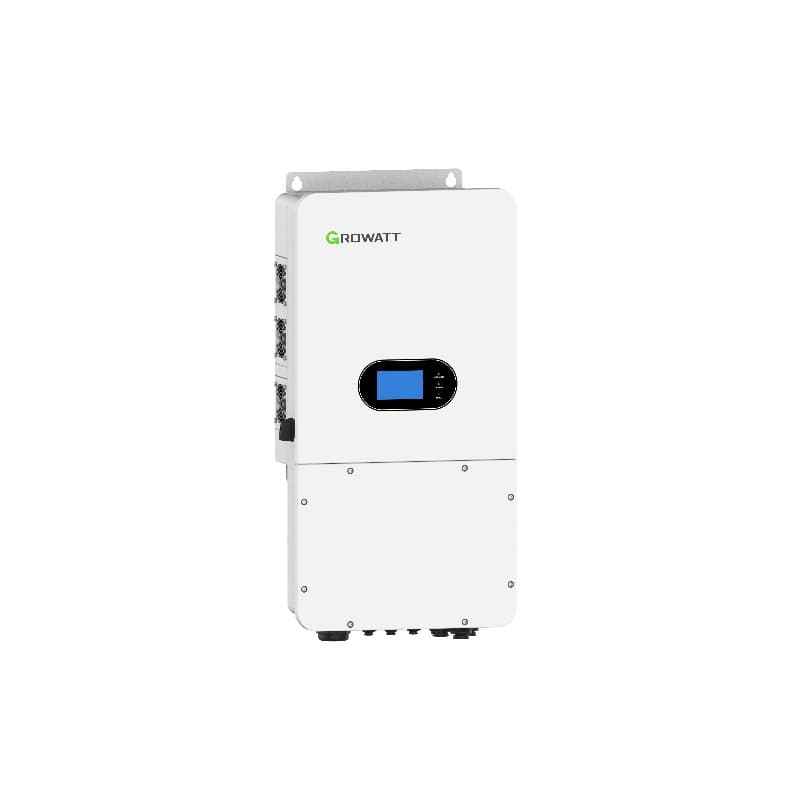
Pair a Growatt SPH hybrid inverter with a home EV charger and rooftop solar. Sizing math, smart load management, real ROI numbers and SKU recommendations.
Driving on sunlight is no longer a tech-blog fantasy. With a Growatt SPH hybrid inverter, a properly sized rooftop array, and a smart EV charger, a typical family sedan or compact SUV can run on solar for 80-90% of its annual mileage. This guide walks you through the sizing maths, the wiring choices, and the real-world payback — using actual Growatt SKUs that we ship and service today.
WhatsApp our team for a free EV-plus-solar sizing assessment. Send your monthly utility bill, the car's battery size and your typical daily mileage and we'll come back with a system within an hour.
Why pair Growatt solar with home EV charging?
Three things make 2026 the right year to combine them. First, EV-charging time-of-use (TOU) tariffs in most regions now penalise evening charging by 2-3x the day-rate. Second, residential hybrid inverters from Growatt (SPH, SPA and SPF series) can now act as smart load controllers — diverting surplus solar into the EV charger before exporting to the grid. Third, Level-2 home chargers have dropped to under $600, while a Growatt SPH 5-10 kW system delivers 18-40 kWh of clean daytime energy.
The net effect: a household driving 50 km/day in an EV consuming 16 kWh/100 km needs about 8 kWh of charging per day. A 5 kW Growatt array on a sunny rooftop produces roughly 25-30 kWh/day — more than enough to run the house and the car, with battery surplus left over for the evening.
Sizing math: how much solar does your EV actually need?
Start with the EV's energy demand per kilometre. Most 2024-2026 EVs consume 14-22 kWh per 100 km depending on weight, climate control use, and traffic. Multiply by your average daily distance:
- Light commute (30 km/day): 4.5-6.5 kWh/day → 1.5-2 kW of dedicated solar
- Standard commute (50 km/day): 7-11 kWh/day → 2.5-3.5 kW of dedicated solar
- Heavy use (100 km/day): 14-22 kWh/day → 5-7 kW of dedicated solar
That's on top of your normal household load. A 4-person household with 2 ACs and a fridge runs about 18-25 kWh/day in summer. Add the EV and you're looking at 25-45 kWh/day total. Translate that into a Growatt sizing recommendation:
| Profile | Total daily load | Recommended Growatt inverter | PV array | Battery |
|---|---|---|---|---|
| Apartment + light EV | 15-20 kWh | MIN 5000TL-XH (5 kW hybrid) | 5-6 kWp | 5-10 kWh APX |
| Villa + standard EV | 25-35 kWh | SPH 6000TL-BL-UP (6 kW) | 8-10 kWp | 10-15 kWh APX HV |
| Villa + heavy EV / 2 cars | 40-60 kWh | SPH 10000TL3-BH-UP (10 kW 3-phase) | 12-15 kWp | 15-25 kWh APX HV |
| Large home + 2 EVs + pool | 60-90 kWh | SPA 10000TL3-BH-UP + SPH parallel | 15-20 kWp | 25-40 kWh APX HV |
Choosing between Growatt SPH, SPA and SPF for EV setups
Growatt sells three hybrid families that all work with EV charging, but the right pick depends on your grid situation:
- SPH 3000-6000TL-BL-UP (single-phase): the workhorse for villas with a single-phase utility connection. Native battery interface, smart export limit, ShinePhone monitoring. Best price for a 5-7 kW solar + 1 EV setup.
- SPH 4000-10000TL3-BH-UP (three-phase): required if you plan to run a 11 kW or 22 kW three-phase EV charger. Balances loads across L1/L2/L3 and avoids tripping the main breaker.
- SPA 4000-10000TL3-BH-UP: AC-coupled retrofit option if you already have a string inverter. Plugs into the AC bus and adds battery + EV-priority logic without replacing existing hardware.
- SPF 4000-18000T-DVM-MPV: off-grid / weak-grid setups. Useful for farmhouses or rural villas with frequent outages where the EV must still charge.
Smart load management: making the EV "drink" only sunshine
The magic happens in the Growatt ShineMaster controller and the Smart Energy Meter. Once the inverter sees that the PV is producing more than the house consumes, it can:
- Send the surplus to the battery (priority 1) until SOC hits 95%.
- Divert excess to the EV charger via a configurable digital output or Modbus signal (priority 2).
- Export the rest to the grid at the net-billing tariff (priority 3).
If you wire a compatible Level-2 charger (Wallbox Pulsar Plus, Schneider EVlink, Zappi, or one of the Chinese OEM models tested with Growatt's CT input) the charger receives a modulated power signal and adjusts the EV's draw in real time. The car effectively eats the solar as fast as it arrives — no grid energy required.
If your charger doesn't support modulation, you can still schedule it to start at 10:00 and stop at 16:00 (the solar window), which captures 70-80% of the benefit with zero electronics.
Wiring and electrical considerations
A few non-obvious points matter:
- Dedicated breaker: the EV charger always sits on its own 32 A or 40 A breaker, separate from the house critical-loads panel.
- RCD type: EV chargers need a Type-B RCD (or Type-A plus a 6 mA DC monitoring built into the charger). Cheap Type-AC RCDs trip nuisance faults.
- Cable size: a 7 kW single-phase charger needs a 6 mm² cable at minimum; longer runs may need 10 mm².
- Inverter export limit: set the Growatt export limit so that the EV draw plus household plus battery charge never exceeds your grid connection capacity. ShinePhone makes this a single slider.
- Phase balancing: if you're on three-phase, install the charger on the phase that carries the lowest baseline load (usually L1 in most homes).
Real-world ROI: a worked example
Take a four-bedroom villa with a 2024 Tesla Model 3 RWD driving 55 km/day. The car consumes 14.5 kWh/100 km, so 8 kWh/day or roughly 240 kWh/month. At a TOU evening rate of $0.32/kWh, charging from the grid costs about $77/month. Charging from solar costs effectively $0 once the system is paid off.
The household also pays $180/month for AC, lighting and appliances. Total monthly spend before solar: $257.
System cost: a Growatt SPH 6000TL-BL-UP with 9 kWp of bifacial panels and a 10 kWh APX HV battery, fully installed in a Tier-1 city, lands around $11,500-13,000. Annual savings: $3,084. Simple payback: 3.7-4.2 years. Over 25 years (typical panel warranty) the system saves north of $75,000 — and that's before factoring fuel-cost inflation.
Even households that drive less still benefit. A retiree with a 25 km/day commute gets 80% of the savings at 60% of the system cost, because the EV piece of the equation is the marginal addition, not the foundation.
Common mistakes to avoid
- Buying a charger before the inverter. The charger has to talk to the inverter, not the other way around. Check Growatt's compatibility list first.
- Undersizing the inverter to save $500. A 5 kW inverter on a 9 kW array clips production in summer. Stay near DC/AC = 1.2-1.3.
- Skipping the smart energy meter. Without the CT clamps, the inverter can't see export and can't prioritise the EV. The meter is $80 and mandatory.
- Putting the EV on a non-backup circuit. If you want the EV to still charge during an outage from battery, wire it to the inverter's backup output (within power limits).
- Ignoring the utility's grid-connect approval. Adding a 22 kW charger may push you over the residential connection cap and require an upgrade fee.
What about V2H / V2G (bi-directional charging)?
Growatt's SPH G3 firmware (released Q1 2026) adds CCS V2L compatibility, meaning some EVs (Hyundai Ioniq 5, Kia EV6, Ford F-150 Lightning) can feed the home through a CCS V2H box. Full V2G — exporting from the car to the grid — is still pending UL/IEC certification in most markets. Don't buy on the V2G promise yet; buy for V2L and treat V2G as a future bonus.
Next steps
If you're sizing a system, start with our Growatt backup-power guide for outage planning, then read the low-yield troubleshooting guide so you can spot underperformance early.
Send your monthly bill, car make/model and roof photo on WhatsApp and we'll come back with a turnkey quote within 24 hours.
Frequently Asked Questions
Can I charge my EV directly from a Growatt solar system?
How much solar do I need to power an EV at home?
Which Growatt inverter is best for EV charging?
Does Growatt support bi-directional charging (V2H / V2G)?
What's the payback period for a Growatt solar plus EV setup?
Can the EV still charge during a power outage?
Do I need a three-phase Growatt inverter for an 11 kW EV charger?
Ready for a personalized quote?
WhatsApp us — average reply time under 15 minutes.